
By Jay Collins, Product Manager, Single-use; and Chris Hofmann, Single-use Design Engineer, Charter Medical LLC
October 30, 2023
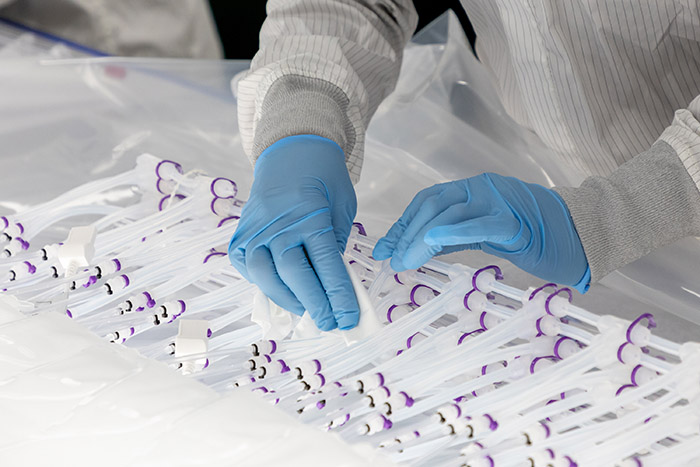 Designing a scalable process for cell and gene therapy production requires therapy developers to have an early understanding of how the various components of a single-use system can be designed to streamline the journey to commercial scale.
Therapy manufacturing processes designed with a high level of flexibility ultimately increase process efficiency, decrease risk, and save costs. Single-use manifolds – an assembly of bags and other components – bring flexibility to the manufacturing process because they enable final or in-process fluid to be transferred into multiple bags at the same time in a closed-system. Customizable manifolds offer a range of process advantages for advanced therapy manufacturing, including scalability, safety, reliability, and speed.
In the early development stage of building single-use manifolds, Charter Medical’s team of expert single-use engineers are often asked questions about design and implementation. This Q&A addresses 6 questions that cell and gene therapy manufacturers commonly ask when designing custom single-use manifolds for critical biological fluid handling.
Question #1: How does an effective manifold design help manufacturers achieve their goals quicker?
Manifolds bring at least 6 key benefits to the manufacturing process, including:
1) Reducing the number of operators for filling operations
2) Mitigating process risks (e.g., particulates, leaks from welding issues)
3) Optimizing current workspace limitations
4) Decreasing safety risks to operators (e.g., decreasing contact with viral vectors)
5) Reducing operational timing
6) Reducing contamination by shifting from an open-system to a closed-system process
Question #2: What filling methods can single-use manifolds be used for?
Single-use manifolds can be developed to operate within both automated and manual filling processes. Consider both avenues if you have long-term plans to scale with automatic filling.
Question #3: How do I determine the right-sized manifold?
There are several factors to consider when designing and determining the right-sized manifold to fit your fill process:
- Volume of source material for transfer into final bags
- Size of the work environment (e.g., cleanroom, biosafety cabinet, benchtop)
- Methods required for connecting and disconnecting tubing as well as the recovery process for source material liquids
- Number of operators needed for filling
Question #4: How does the fluid transfer process influence the design of a manifold?
Consider the following when designing a manifold:
- Is a manual or automated filling process used?
- Will the filling be gravity-fed or are peristaltic pumps used?
- How is the source bag connected to the manifold?
- Are there specific connectors that need to be included in the design?
- How many clamps are needed to control the fluid pathway?
- What are the storage conditions after filling?
- What techniques or equipment will be used if sterile welding is utilized?
- Is in-process sampling needed during the filling process?
- How is the final bag volume controlled?
- Are you considering the use of pH and/or temperature sensors?
Question #5: Based on the application, what type of bag is recommended?
Several bags can be used according to the application and the product stage (e.g., cell expansion, intermediate filling, final filling, or long-term storage):
1) Cryopreservation: polyolefin film material is ideal for intermediate, final fill, and viral vector filling stages. Charter recommends the following single-use bags for cryopreservation:
Cell Freeze® Cryogenic Containers
Freeze-Pak™ Bio-Containers
Freeze-Pak™ STS
Freeze-Pak™ with FP-FLEX™
2) Media storage: a multi-layer polyolefin film is ideal for storage. Charter recommends the following single-use bags for media storage:
Bio-Pak® Small Volume Bio-containers
3) Cell expansion: polyolefin film material is ideal for protecting materials during freezing and thawing. Charter recommends the following single-use bags for cell expansion:
Cell Expansion Containers
Question #6: What additional factors should be considered when designing a manifold?
There are many additional aspects that may be important when designing a manifold:
- Level of sterility needed
- Specific materials of construction required for use
- Required testing qualifications, documents, and declarations
- Validation testing documents to adhere to process development standards
- Budget
Connect with the Single-use Manifold Experts Today
Charter Medical’s team of single-use development engineers have decades of experience partnering with therapy developers to understand their current and future needs for any level of fluid processing customization. Explore our manifold design service or connect with us to start designing your single-use manifold today.